Showing posts with label streets. Show all posts

Sunday, 19 June 2022

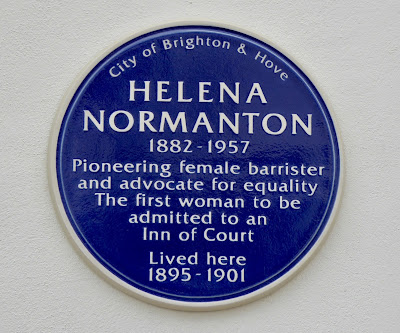
A Plaque for Helen Normanton


This plaque, unveiled yesterday, owes its existence to the efforts of twin sisters attending Brighton College. They chanced upon Helen's grave in Ovingdean churchyard and, their interest sparked, went on to meticulously research her background. This led into a successful campaign for a plaque on 4 Clifton Place where Helen spent her formative years and first formed the ambiton to enter the legal profession, undaunted by the fact that it was closed to women at that time.


The proceedings were opened by songs from a small choir of fellow pupils and a welcoming address was given by the sisters.  This was followed by speeches from:-
  • Dr Angela Owen-Smith, a relative of Helen (delivered by her daughter).
  • Professor Judith Bourne, Head of Law at St. Mary's University, associate member of Normanton Chambers and author of 'Helen Normanton and the Opening of the Bar to Women'.
  • Professor Nicky Padfield QC, Master of the Bench at Middle Temple and Professor of Law at Cambridge University
  • Dr. Helen Dancer, Senior Lecturer in Law at the University of Sussex and beneficiary of the Helen Normanton Ph.D Foundation.
  • The City Mayor Lizzie Deane.


The sisters haven't stopped with this success but have now become Child Ambassadors involved in promoting and fund-raising for the Mary Clarke Statue Appeal.

Thursday, 26 May 2022

A Plaque for the Hilton Twins


The City Mayor, Cllr Alan Robins, today unveiled a plaque at 18 Riley Road to the Hilton Twins.  

The twins, although exploited during their early life, gained freedom from their "guardians' at the age of 23. They went on to rise above their physical challenges and for many years became widely celebrated for their musical talents alone. However the mid 20th.C saw their popularity fade. Lacking work and money they ended up in Charlotte, North Carolina employed in a local shop. 

They died during the Hong Kong flu epidmic, Daisy preceding Violet by a few days and were buried together at the local graveyard.


This was the 6th and last plaque unveiling performed by Cllr Robin during his mayoral tenure.
 

Monday, 24 January 2022

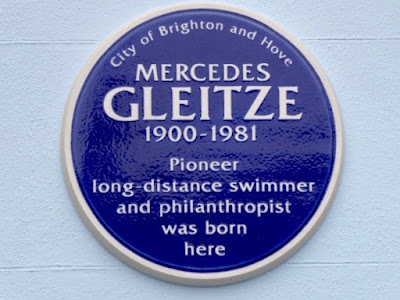
A Plaque to Mercedes Gleitze


A remarkable female athlete was commemorated today with the unveiling of a plaque at 124 Freshfield Road by the City Mayor.  

In 1927 Mercedes became the first British woman to swim the English Channel and in the following year the first person to swim the Straits of Gibralter. Other sponsored long distant and endurance swims followed, and in 1933 Mercedes used the funds generated to set up the first Gleitze Home for destitute people. The charity's work continues to this day.

A film "Vindication Swim" dealing with Mercedes' exploits in the English Channel is to be released later this year. The unveiling ceremony was attended by the film's star Kirsten Callaghan and director Elliot Hasler (photos below).


Thursday, 28 October 2021

A Plaque to Rabindranath Tagore


A plaque was unveiled by the City Mayor today at 7 Ship Street to commemorate Rabindranath's connection with the city. Brighton & Hove was the first place he lived in outside of India. Rabindranath was born into a wealthy Bengali Brahmin family and built on and transcended these roots, embracing universalism and humanism. He became a poet, philospher, novelist, visual artist, composer and activist. In 1913 he became the first non-westerner to be awarded the Nobel Prize for Literature and in 1915 he was knighted by King George V for his services to literature.

Addresses were given by:-

Roger Amerena, Chairman of the Brighton & Hove Commemorative Plaque Panel.
Her Excellency the High Commissioner for Bangladesh.
Dr Kalyan Kundu, Tagore Centre UK.
Professor Shahaduz Zaman University of Sussex.
Dr Jeanne Openshaw, University of Edinburgh.

The Salvation Army Band provided welcoming music and the National Anthems.


Tuesday, 30 March 2021

The "Surrey Style" in Hove.


In the closing decades of the 19thC sources as diverse as the writings of William Morris and the cottage paintings of Helen Allingham had created an idealised version of country life in the collective Victorian mind.  Wealthy Londoners, encouraged by the expansion of railway lines serving the capital, began to look beyond metroland to the hills and woodlands of Surrey for their retirement homes. In what was then a mainly rural county the supply of suitable properties was limited and they turned to architects such as Lutyens (influenced by Gertude Jekyll), Falkner, Bailey and Nevill to help fulfil their rural idyll. 

Apprised of their clients' domestic and comfort needs the architects turned to the Surrey vernacular for inspiration and found it in the various combinations of red-brick, red-tiles and the occasional timber framing. The Surrey style was born. Unaccountably what later came to signpost the Surrey Style were  imposing chimneys which, whatever decorative features they incorporated, were always large.

The architect of 11 Grand Avenue, Hove, was A. Faulkner. It was built by William Willett, 1900-1903. The manner in which it has, over the years, withstood the ravages of time in what is quite an exposed location bears witness to the quality of the build. It is Grade II listed with Historic England.

Thursday, 2 April 2020

Brighton Place - then & now

2nd April 2010

20th April 2019
It is gratifying that the attractive development of Hanningtons Lane has yielded a glimpse of the end wall of Puget's Cottage, the oldest building in the Old Town, and beyond it, the cupola of the Leeds Permanent building in North Street.

See also: Brighton Place


Saturday, 21 March 2020

At Patcham Roundabout - then & now


Then. The pumping station, which can be seen beyond the railway line, was built in 1889 so this postcard is dated later than that but before the age of the motor car swept all of this away. Note that the railway bridge is a simple brick arch. On the left can be seen the flint wall of Patcham Place, most of which was demolished when the Patcham by-pass was built in 1926.  See also: Patcham Village - then & now.

2020

Now.
With the growth of motor transport came the need to provide the same headroom over the whole width of the road and the brick arch was replaced with beams supported at their ends on the original brickwork which left the width of the roadway unchanged.

The roundabout today doesn't get any prettier
The roundabout was part of Brighton bypass scheme completed in 1995. Before then the A23 crossover from Mill Road to Vale Avenue was controlled by lights.


Sunday, 8 March 2020

The Shakespeare's Head - then & now

1 Spring Street
The Shakespeare's Head was built in the 1830s as part of the development of Spring Street which had started in the late 1820s. It was sited on the southern corner of Hampton Street on the back plot to 157 Western Road which later became part of Boots the Chemists. Boots originally occupied 157 to 162 Western Road to the west of Spring Street. The photo shows the Shakespeare's Head in 1935 after most of the north side of Western Road between Hampton Place had been demolished for the Mitre House development. By then Boots had moved to purpose-built premises between Spring Street and Dean Street taking some of the street numbers with them.

The Shakespeare's Head was rebuilt in typical 1930s style retaining the corner entrance to the public bar and flourished for over 3 decades under landlord Sidney Berger. It closed about 10 years ago and two side entrances to other bars were replaced with windows. It now serves as the breakfast room of the Britannia Study Hotel in Mitre House.


In 2020
Today the only remaining hint to its history is in the coloured plaque of Shakespeare's head surmounting  the corner doorway.

See also - Spring Street - then & now
                 More on Spring Street shops


Tuesday, 11 February 2020

Upper Russell Street (2)


Before it was cleared in the 1960s, for the building of Churchill Square, Upper Russell Street ran parallel to Western Road from Clarence Square to near the top of Regency Road where it turned sharply north to join Western Road alongside the Lamb & Flag (now Crowns) pub. It could not join up with the west end of Regency Road because it was on a higher level. Instead a rough grassy bank existed between the corner of Upper Russell Street and Regency Road, probably about 10 feet below. 

Upper Russell Street now lies under the Churchill Square 1 car park where it roughly follows the ground floor central east-west feeder lane.


Google Earth view of the area today.

Below are two photos from the RP&M Collections of the northward running section of Upper Russell Street in the 1950s.


The side of the still existing Lamb & Flag can be seen in the distance.


On the right of the photo is the southernmost building of this section of Upper Russell Street which flanked the bank down to Regency Road.


Tuesday, 27 August 2019

Withdean developments

An earlier post 'Suburban creep' (4 years ago) lamented the gradual loss of semi-rural Withdean, its 1930s houses, mature gardens, and the 'country lane' look of the roadsides. In 2019 unfortunately there is no sign of relief. The two photos immediately below show 4 completed properties in Withdean Road. Some trees have been replanted and will no doubt eventually soften the view somewhat but nothing will disguise the hard fencing.


Elsewhere, unprotected by conservation area status or any other listings, the demolitions have continued. 

Withdean Avenue

Withdean Road

Withdean Road

The clearances so far, with no doubt most of the mature vegetation, has resulted in a large vacant plot which was the subject of planning application BH2016/06478 for a two-part, 3 storey building comprising 26 residential apartments.

Tuesday, 8 January 2019

Hanningtons Lane progress

From Meeting House Lane

From Brighton Place.

Hanningtons Lane viewed from each end is only now beginning to emerge from the scaffolding although completion was originally expected mid-2018.

Monday, 26 November 2018

West Street - then & now

Looking north from Boyces St.
West Street was originally much narrower than shown here. The eastern (r.h. side) was widened in 1868 and the Academy cinema on the same side built in 1911. Widening of the western side did not start until 1928 which dates this picture to the period 1911-1928.

On the corner of Boyces Street, the Half Moon lasted until at least 1970 when the licensee was a 'Gizzi', a family more usually associated with Italian ice cream. Although at first sight the building now looks completely different it seems to have retained the same fenestration even though it has had the roof replaced.

Of the two buildings up from the Half Moon, 61 West Street with the canted first-floor bays appears still intact, but 62 with the elegant first-floor bow window has been replaced with modern mock-Georgian.


The building that replaced the Academy deserves no comment.


Saturday, 24 November 2018

A Plaque to Lt. Jacqueline Nearne


This plaque originally unveiled at a special ceremony in November 2106 has found its permanent home at Jaqueline's birthplace, 32 West Hill Street.

She moved with her family to France in 1923. When France fell, she made her way back to England  and joined the First Aid Nursing Yeomanry.  Nearne's fluency in French quickly brought her to the attention of the Special Operations Executive (SOE) where, in 1942, she trained as a courier for the French Resisitance.

On 25 January 1943, she was parachuted into France to work for the 'Stationer' circuit in central France and maintained contact with SOE networks in the Paris area. She carried spare parts for radios inside a cosmetics bag. After fifteen months in the field, she finally returned to Britain in April 1944.

In 1946 she played "Cat", a character based on herself, in the RAF drama-documentary School for Danger, 1948, about the wartime training and deployment of SOE operatives.

Thursday, 22 November 2018

Little Russell Street

c.1950 
Photo:RPM
Little Russell Street looking east from near its junction with Russell Street which now lies under the Churchill Centre. The 1958 street directory lists just the three properties on the left, no.15, a motor repairers, 15a & 16, privately occupied, and further down the entrance to St. Paul's School. At the far end on the left can be seen the side of the old Odeon cinema in West Street which was demolished in 1990.

Little Russell Street is now the easterly part of Russell Road and Russell Place is now located at the former entrance to the school. St. Paul's school moved to St. Nicholas Road in 1967. 

Russell Road today.

Sunday, 18 November 2018

A Plaque to Minnie Turner


The first of a series of plaques planned to commemorate the centenary of a significant period in the Women's Suffrage movement was unveiled today at 13 Victoria Road. Minnie Turner ran her boarding house Sea View as both holiday destination and refuge for suffragettes recovering from imprisonment, hunger-strikes and forcible feeding.

Minnie was present exactly 100 years ago today when suffragettes marching to Parliament were violently attacked by police for six hours. Also present were several of her former guests and, in particular, her boarder, Mary Clarke, the WSPU organiser for Brighton, who later tragically died.

Minnie Turner was for 12 years the Honorary Secretary of a branch of the Brighton Women’s Liberal Association and a member of the National Union of Women's Suffrage Societies (NUWSS). In 1908, frustrated at the government’s refusal to grant women the Vote, she joined the militant WSPU.

Minnie expressed great pride that more of the suffragette leaders and speakers had stayed with her than in any other home.

The plaque was funded by the City Council with a contribution from the Brighton & Hove Heritage Commission.


Members of the Women's History Group who researched and proposed the plaque.


Monday, 5 November 2018

New bus shelters.

The city is to get 5 new bus shelters at sites prioritised  according to the exposure to weather, distance from any other shelter, and number of requests from the public.

Warren Road, top of Bear Rd.

Warren Road, top of Wilson Av.

Grand Avenue, Kings House

Stanley Deason Leisure Centre, Wilson Avenue

New England Rise.
The estimated cost is £550,000 which is over £100,000 each. It seems on the high side for a fairly basic, largely refabricated, structure, but I suppose there are reasons . . .