Thursday, 10 March 2022

A Plaque for Lewes Road Hospital


In the early 20thC poor food, bad housing conditions and overwork inevitably led to poor health which in turn produced mental stress and, untreated, what was then termed nervous breakdown. No help was available to the poor until their condition worsened to the extent that they could be certified as mentally insane and committed to an asylum for treatment at the state's expense.

Dr Boyle had the insight to understand that early intercession, including treatment for physical problems, by sympathetic female doctors could do much to relieve suffering.

The unveiling at 101 Roundhill Crescent by the City Mayor was preceded by addresses from:-

Roger Amerena, Chairman, Brighton & Hove Commemorative Plaque Panel.
Worshipful the Mayor, Cllr. Alan Robins.
Caroline Lucas MP, (read by Vivien Elliades)
Cast members of "Clean"*.
Rachael Kenny, Dir. Mental Health Services, BHT Sussex.
Anna McDevitt, MIND.
Angelika Wydra, Healthwatch Brighton & Hove.
Hon. Alderman Brian Fitch, Vice Chariman , Brighton & Hove Heritage Commission.


Monday, 24 January 2022

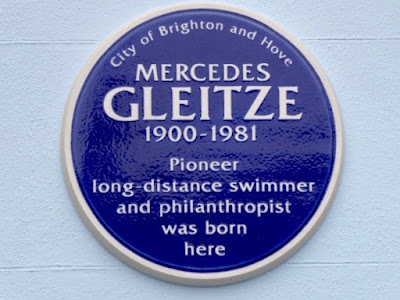
A Plaque to Mercedes Gleitze


A remarkable female athlete was commemorated today with the unveiling of a plaque at 124 Freshfield Road by the City Mayor.  

In 1927 Mercedes became the first British woman to swim the English Channel and in the following year the first person to swim the Straits of Gibralter. Other sponsored long distant and endurance swims followed, and in 1933 Mercedes used the funds generated to set up the first Gleitze Home for destitute people. The charity's work continues to this day.

A film "Vindication Swim" dealing with Mercedes' exploits in the English Channel is to be released later this year. The unveiling ceremony was attended by the film's star Kirsten Callaghan and director Elliot Hasler (photos below).


Thursday, 28 October 2021

A Plaque to Rabindranath Tagore


A plaque was unveiled by the City Mayor today at 7 Ship Street to commemorate Rabindranath's connection with the city. Brighton & Hove was the first place he lived in outside of India. Rabindranath was born into a wealthy Bengali Brahmin family and built on and transcended these roots, embracing universalism and humanism. He became a poet, philospher, novelist, visual artist, composer and activist. In 1913 he became the first non-westerner to be awarded the Nobel Prize for Literature and in 1915 he was knighted by King George V for his services to literature.

Addresses were given by:-

Roger Amerena, Chairman of the Brighton & Hove Commemorative Plaque Panel.
Her Excellency the High Commissioner for Bangladesh.
Dr Kalyan Kundu, Tagore Centre UK.
Professor Shahaduz Zaman University of Sussex.
Dr Jeanne Openshaw, University of Edinburgh.

The Salvation Army Band provided welcoming music and the National Anthems.


Wednesday, 26 May 2021

A Plaque to Elizabeth Robins and Octavia Wilberforce


This plaque has now been installed at 24 Montpelier Crescent. Due to infection control measures it was deemed unadvisable to hold an unveiling ceremony. 

Elizabeth Robbins was born in America and moved to London in September 1888. She had a very active and eventful life, great success as an actor and wrote as C.E. Raimond. She met Octavia Wilberforce in 1909. 

Partly supported by Elizabeth and against strong parental oppositions Octavia entered the London School of Medicine for Women in 1913, qualifying in 1920. She entered general practice in Brighton  and ran a women's shelter near Henfield. Octavia was friendly with members of the Bloomsbury Group and treated Virginia Woolf's mental illness towards the end of Woolf's life. She retired in 1954.


Friday, 21 May 2021

Smuggler's Cottage, Rottingdean


The semi-detached cottage shown on the left in the above postcard (see also: Rottingdean) was at one time known as '"Smuggler's Cottage".

The photo on the right shows it in 1957 with a curious object above the downstairs window. It has been suggested that this was an air-raid siren left in place after the war but it seems to be the wrong shape for that.  Closer inspection reveals what might be decorative features and a hint that it is barrel-shaped. Was it in fact an ornamental brandy-barrel displayed as a nod to the smuggler's trade and in lieu of a conventional house nameplate?