Showing posts with label urban plunder. Show all posts

Monday, 20 October 2014

Fencing for Patcham Place


An application SDNP/14/03236/FUL to the South Downs National Park Authority to fence the immediate surroundings of Patcham Place has been approved. The green line in the map above indicates the line of the fencing which will be made of mild steel in a traditional estate style. Traditionally wrought iron would have been used but this is no longer commercially available.

There is no evidence that Patcham Place was ever provided with gates but the proposed design is borrowed from existing 18thC examples and is typical of that which would have been used by the provincial gentry. They will be hung from piers of Portland stone with inset panels of knapped flint.

The installation of fencing has been prompted by:- 
  • uncontrolled vehicle parking by third parties whether commuters or users of the adjacent public park and sports pitches.
  • the lack of any perimeter control at night and hence the ability of vehicles to gain free access to the immediate vicinity of the building. 
  • recurrent problems of lead thefts from the roof and the resultant costs and potential for serious damage to the fabric of the listed building. 
Previous post: Patcham Place proposals.

Sunday, 29 August 2010

Thoughts while pondering Steve Ovett's foot . . .

One of the last acts of plunder in Preston Park, the removal in 2007 of the bronze statue of Olympic 800m champion Steve Ovett by sawing it off at the foot. It was well reported at the time, but has an interesting link with an earlier act of vandalism, namely the illegal felling of mature trees just across the London Road on the vacant Anston House site. The unnecessary loss of these trees caused much indignation among local residents, but certain denizens of the alternative, unwaged society took it upon themselves to move in and set up a "Protest the Trees" camp. This involved decrepit caravans, makeshift tents, bonfires and much miscellaneous rubbish.

After the statue disappeared,  the police visited the Anston House site, recovered most of the statue in pieces, and charged a 44 year-old female person, of no fixed address, with possession.  One of the pieces nestled in the remains of  a bonfire, where attempts had apparently been made to melt it down, this neatly demonstrating perhaps why the miscreant was unwaged.

The pieces of the statue were returned to local sculptor Tim Webster whose work it was. Mr Webster  estimated it would cost £30,000 to recreate it. The illegal felling eventually came to court and the owners were fined £30,000 (+£4,000 costs). The female miscreant was simply cautioned.

Wednesday, 25 August 2010

Preston Park 5

This pylon at the southern entrance provides yet another example of urban plunder. As it has the Brighton Coat-of-Arms on the south face which were not granted until 1897, the pylon presumably dates from the 1928, or later remodelling of the entrance. On the east side of the plinth there is a brass plate commemorating the Manor of Radynden. 

On the west side there was once a matching brass plate commemorating the nearby Roman Villa (where Wellend House now stands).  I have no idea how long it has been gone. I first noticed it missing about 2 years ago.

Tuesday, 24 August 2010

Disappearing street lamps

I try to keep up with the local news but have only recently come across this BBC report from back in May.

It probably explains what happened to the lamps outside Marlborough House.

Friday, 20 August 2010

Preston Park 4

This plastic monstrosity may look passable to those who don't recall the original. It replaced a fine lion mask bronze casting which just disappeared overnight about 10 years ago. It was during a period when the rose garden and formal pool were suffering a period of neglect and travellers' vans parked along Preston Park Avenue. The rose garden was subsequently very beautifully  restored with the aid of the Heritage Lottery Fund but money obviously did not stretch to bronze castings. Indeed, what is the point if it is liable to be simply plundered again?

The fountain appears to be plumbed in but I have not seen it working since before the restoration work. Perhaps it needs a new pump.

Monday, 16 August 2010

Preston Park


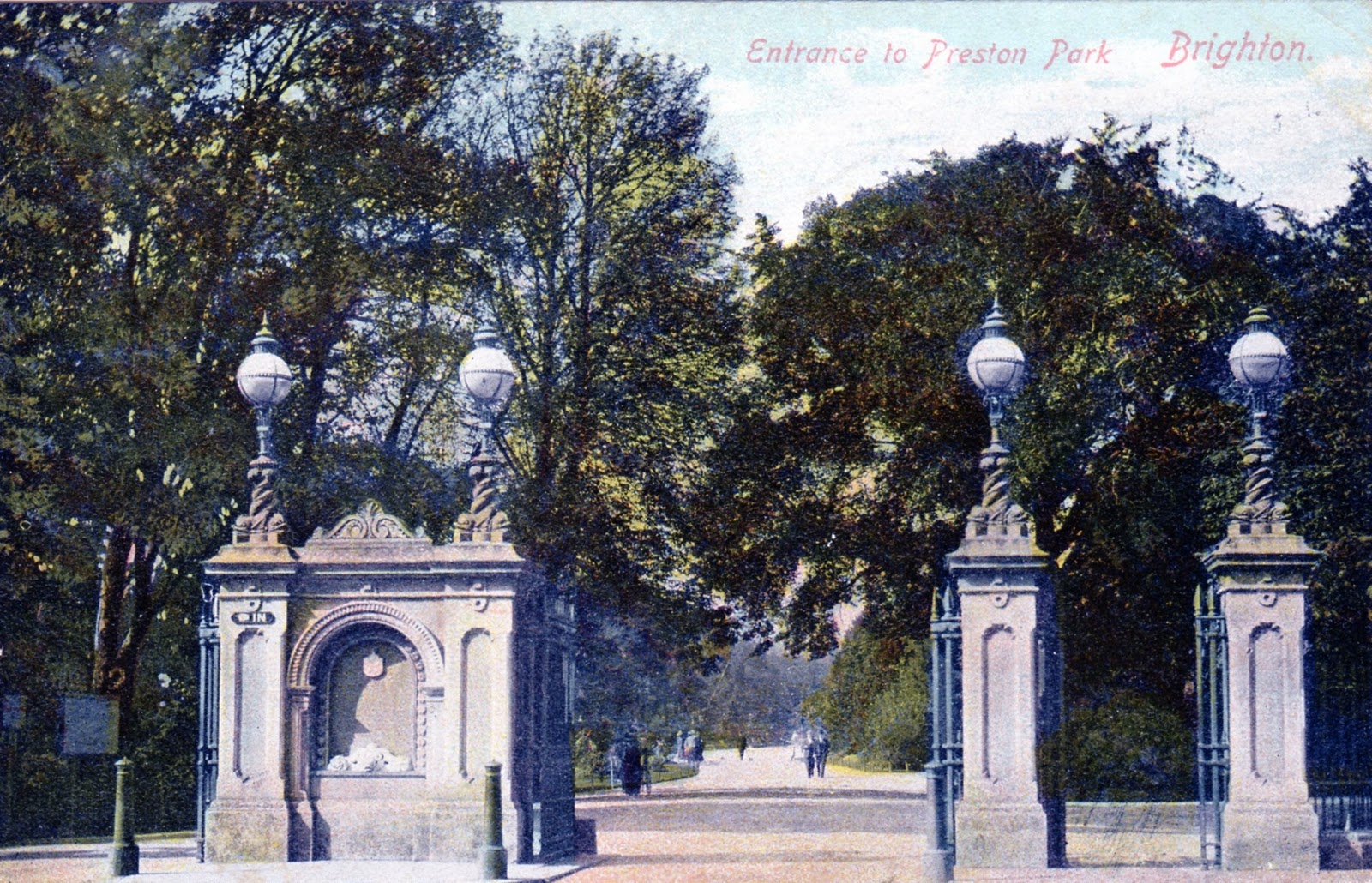
The southern entrance gates from a postcard dated 1915.  The carriage "in" was to the extreme left and the pedestrian entrance to the right. On the extreme right the start of the six foot high iron railings which surrounded the park can just be made out. These were removed as a matter of policy in the 1928 the idea being to 'integrate' parks more into the surrounding area. (Nothing to do with the war effort). The gates would have been locked at night by a park-keeper who lived on site and I can't help thinking that in today's world such an arrangement would be welcomed by most people. It would certainly have helped to prevent the urban plunder and vandalism the Park has suffered in the late 20th Century.

Below is a photo taken from the same viewpoint today. The tree to the extreme left is still there (as I expect are some others) and the curving entrance to the driveway seems to have been preserved. This remodelled entrance dates from the 1930's and contrary to The Encyclopaedia of Brighton article it is clear that the entwined dolphin lamp standards have simply been transferred to the new shorter pillars, not newly designed. However, in the associated  balustrade, the dolphin theme has been attractively reworked.


Tuesday, 27 July 2010

Urban plunder at Marlborough House?


Until May this year each of the two entrances to historic Marlborough House were complemented by an elegant period lantern surmounting each pillar . .

They have now disappeared from both . . .


 . . . and from the way the wires have been left one fears the worse.

Security has recently been tightened at the site . . .


Have the conspicuous notices announcing this fact have merely served to alert thieves to an opportunity?

Thursday, 5 March 2009

Nice staircase . . . .

 . . . shame about the vandals.
This is the central art deco staircase in the Ocean Hotel, Saltdean. It spirals from top to bottom in a graceful swoop and one of its most remarkable features was the continuous handrail in solid brass.   This photo was taken in 2005 but  about 18 months later, shortly before the present developers took the premises over, some "Jack the lads" turned up with a lorry and ripped the handrail out. (Still lets give them the benefit of the doubt - perhaps they wanted to donate the scrap money to "Children in Need"!) Nearby residents saw it happening but assumed they "probably" had permission. The developers are committed to restoring period features but what's the betting the new handrail won't be in solid brass.