Showing posts with label pubs. Show all posts

Sunday, 8 March 2020

The Shakespeare's Head - then & now

1 Spring Street
The Shakespeare's Head was built in the 1830s as part of the development of Spring Street which had started in the late 1820s. It was sited on the southern corner of Hampton Street on the back plot to 157 Western Road which later became part of Boots the Chemists. Boots originally occupied 157 to 162 Western Road to the west of Spring Street. The photo shows the Shakespeare's Head in 1935 after most of the north side of Western Road between Hampton Place had been demolished for the Mitre House development. By then Boots had moved to purpose-built premises between Spring Street and Dean Street taking some of the street numbers with them.

The Shakespeare's Head was rebuilt in typical 1930s style retaining the corner entrance to the public bar and flourished for over 3 decades under landlord Sidney Berger. It closed about 10 years ago and two side entrances to other bars were replaced with windows. It now serves as the breakfast room of the Britannia Study Hotel in Mitre House.


In 2020
Today the only remaining hint to its history is in the coloured plaque of Shakespeare's head surmounting  the corner doorway.

See also - Spring Street - then & now
                 More on Spring Street shops


Friday, 27 October 2017

Tuesday, 17 October 2017

The William IV pub renovation

Before

After
The William IV pub on the corner of Bond & Church Streets has no doubt gone through many transformations in its 170year+ history. The latest this year by the pub group Indigo has revealed the original cobble walls and retained the United Ales green tiling. It has also regained a hanging sign,

But the painted signage looks cheap & nasty compared with the previous raised gilt lettering. I hope they've kept the letters for when the fashion cycle turns back again.

Tuesday, 16 May 2017

The East/West Divide

The old Free Butt Inn, Albion Street, looking very sad.

The Eagle, Gloucester Road, looking very lively.
Albion Street is situated at the north west corner of an area that was subjected to repeated slum clearances and redevelopment throughout the 20th.C. Many streets of 2 to 3 storey housing were demolished and replaced with the blocks of flats to be seen today. This area was situated in what was known as Hilly Laine. The rest of Hilly Laine survived and became a much sought-after area now known as Hanover. Hanover still supports many thriving pubs.

On the opposite side of the central valley North Laine also narrowly escaped demolition in the 60's thanks mainly to the efforts of BHCC Planning Director Ken Fines. This is now a lively mixed retail, commercial and residential area which is a favoured destination for both Brighton residents and visitors alike.

The current plans for the remodelling of Valley Gardens and its encircling road system has the aim of rendering the Valley Gardens more permeable to pedestrians west to east. and vice versa. Once completed perhaps some of the buzz of the west side will bleed into the east. It looks doubtful though that it will happen in time to save the Free Butt.

Friday, 20 March 2015

The Black Horse - then, later, now

February 2008
January 2010
March 2015
The message here is don't change anything until you are sure . . .

Tuesday, 17 February 2015

The Royal Standard - update

8th Feb 2015


No change - the southerly pillared cupola is still missing.

No planning application appears to have been submitted for its removal.

Previous post (15 months ago) : The Royal Standard

Wednesday, 8 October 2014

The Rosehill Tavern

Earlier this year this, now vacant, 144 year old public house became the second property in the City (after Saltdean Lido) to be added to the Council's "List of Assets of Community Value".

A building or other land is an asset of community value if its main use is - or has recently been - to further the social wellbeing or social interests of the local community and could do so in the future. The Localism Act states that 'social interests' include cultural, recreational and sporting interests. Homes, hotels, assets being transferred between kindred businesses, and Church of England land holdings, are exempt from listing.

The "Save the Rose Hill Tavern Campaign" has a facebook page here and a petition here.

The Brighton & South Downs branch of  the Campaign for Real Ale, (CAMRA)
has a more general, but relevant, epetition on the BHCC website here.

Saturday, 16 November 2013

The Royal Standard


This fine Victorian pub in Queen's Road was built c.1857 so no wonder it is showing signs of age.  And, after it was  covered in scaffolding for several months recently, I was looking forward to seeing a splendid restoration job.

I was doomed to disappointment; the only visible difference seems to be the removal of one of the cupolas. Maybe it's just the first stage and it's away being repaired . . .?


Saturday, 4 May 2013

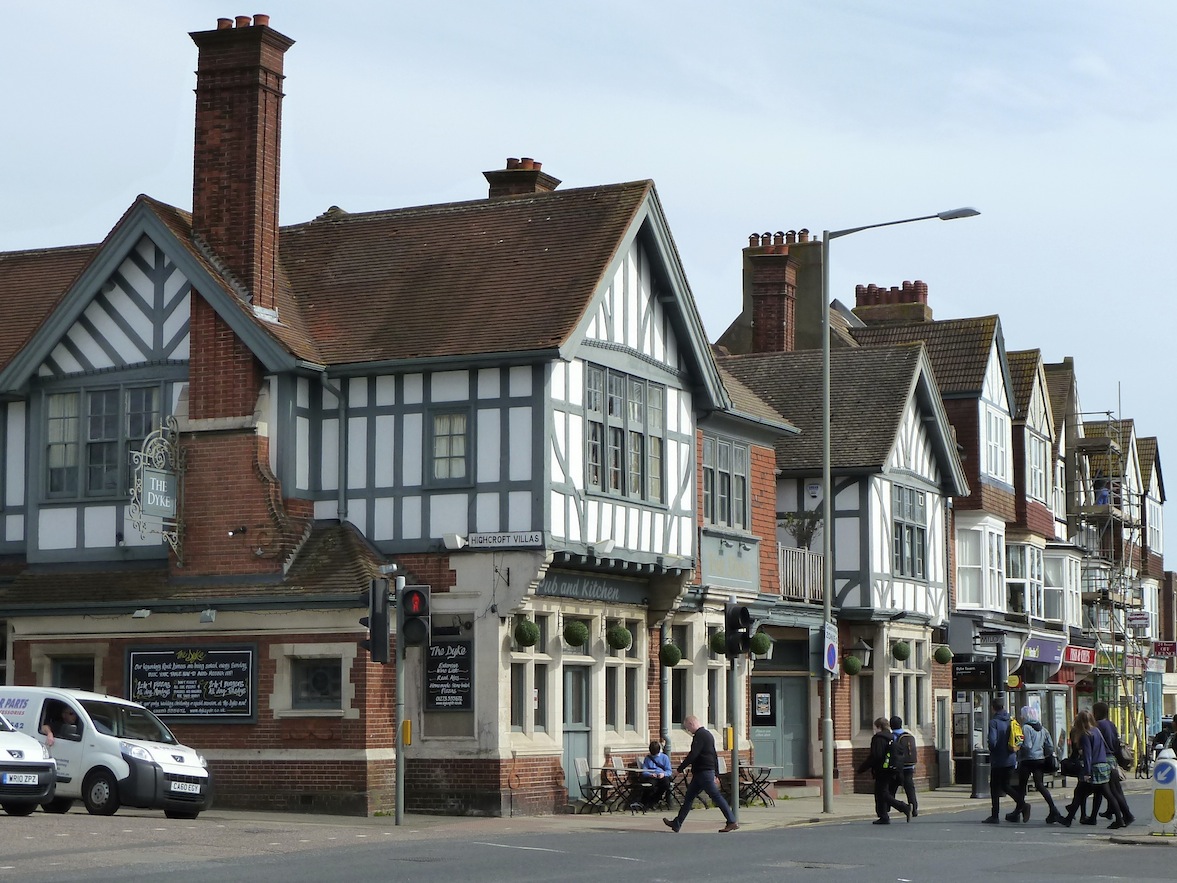
The Dyke Road Tavern


The Dyke Pub & Kitchen (formerly the Dyke Road Tavern)  stands on the site of the former Windmill Inn . This was named for Trusler's Mill, which stood nearby, and was the northernmost of several mills along the Dyke Road Ridge. Other mills were at Port Hall and Belmont. Trusler's mill was demolished c.1890. The Inn was also owned by the miller William Trusler, first as the Windmill Inn and then Dyke Road Hotel, until 1905. Reference to the mill is preserved in the naming of "Old Mill Mews" which runs behind the pub.

The present building dates from c.1896 and is an impressive example of a purpose-built public house in Tudor revival style. It showcases all the characteristic features & flourishes; half-timbering, jettying, mullioned windows, tall chimneys. window-leading, etched glass. All executed to the highest standard of workmanship.

Sunday, 7 April 2013

The Kings Head Hotel


The Kings Head hotel & livery yard stood at 9 West Street, possibly on the site of the original George Inn reputed to be the inn in which Charles II stayed the night before his escape to France. A later George Inn was built at 1 West Street (actually on the corner of Kent Street now disappeared beneath the Kingswest Centre).


In the 1930's the site was cleared for a Sports Stadium, SS Brighton, containing  a large swimming pool. This opened in 1934, but the following year was converted to an ice-skating rink.


The site was returned to the hostelry business in the 1990's with the opening of the Oak Hotel (another reference to the Royal Escape maybe?). It is now a Travelodge.

See also:- West Street: then & now (2)

Wednesday, 25 July 2012

The White Horse Hotel - then & now

c.1906
The front door of this Rottingdean hotel was then on its south side. The cliff-top road from Brighton passed in front of the hotel and then turned sharp left up the High Street. After a short distance it then made a right turn to resume its easterly progress to Newhaven.

2010
The hotel was rebuilt in 1934 to the south and west of the old hotel, and the coast road now passes to the north of it. Some of the properties on the near right are substantially unaltered from the date of the earlier picture, but the red-brick properties, on the NE corner of Marine Drive (the coast road), also date from the 1930's.

Some other posts on Rottingdean:-
Rottingdean
Rottingdean High Street - then & now
Rottingdean from the east - then & now

Thursday, 24 May 2012

20 & 21 Western Road, Hove

Number 21, The Western Hotel, is included in the Local List for Hove where it is described as a; "splendid, exuberant, largely original Edwardian pub now known as O’Reillys". That was back in 1996. It has since been the "Jugglers Arms" and is now "The Paris House", which does seem to suit the style to some extent. However, one wonders as always, what is wrong with the original name  especially since the original, fine mosaic is still largely intact. The Brighton & Hove Pevsner gives the building a passing mention by calling attention to its; "opulent Late Victorian display". "Victorian" seems more accurate than "Edwardian", especially if one is referring to style rather than date. Shame about the neglect of the upper floors and the modern slapped-on lamp-fitting.


The contrast in style with number 20 to the left could not be starker. Its upper floors are Grade II listed with English Heritage and the reason becomes clear when one's eye falls on the ammonite capital. It is said to be by local architects Charles Busby and Amon Henry Wilds. Unfortunately the ground floor was gutted for a new shopfront only a few years ago. In the listing, attention is drawn to; the hipped or pyramid concrete tile roof concealed behind parapet; the curved corner frontage at the junction of Western Road and Upper Market Street; the Ionic pilasters to curved corner and framing window bay onto Western Road, and the plinths cut by inserted fascia of 36-pane bow window with shallow half-dome.


Number 20 was built some 70 years before the Western Hotel. It is otherwise difficult to understand why one should enjoy statutory protection and the other not. They form a fascinating pair and each would be poorer without the other.

Friday, 2 March 2012

"Ye Racehorse Inne"


No. 212 Elm Grove  occupies the corner with Queen's Park Road with great style and confidence. Built in the early 1880s, yet still largely unaltered, it is also a wonderful showcase of the architectural preoccupations of the time; the tudor-revival chimneys, timber-framing, upper sash window panes patterned with glazing bars; the Arts & Crafts style lettering. It is not listed or in a conservation area.

It has recently been closed as a public house, sold, and is now  undergoing  extensive interior alteration to form one 1 bedroom, one 2 bedroom and one 3 bedroom maisonettes. Among the external alterations the windows will all be replaced with double-glazed black UPVC units and the present front door will be replaced with a window. See BH2012/01177.

A small plot of adjacent land on Queen's Park Road is subject to a planning application BH2012/00280 by C J Planning of Rugby Road, Brighton, for the erection of a 3 bed, 2 storey house. The accompanying design statement includes the comment:-
 "A contemporary design approach is considered to be appropriate here as a distinct contrast with the ordered late 19th century terraces on the other side of Queen's Park Road and the ornate “Tudorbeathan” (sic) features of the pub." 

The term "Tudorbethan" was, in fact, coined by poet and conservationist John Betjamen to describe the 20th century mock-tudor style. This style is widespread in Brighton's suburbs, e.g. Woodland Drive: it somehow does not seem to carry the conviction or panache of its 19th century predecessor.


Saturday, 15 October 2011

The Royal Escape


360 years today Charles II landed safely in Fecamp, Normandy, having purportedly spent the previous night in the George Inn, West Street, Brighton, shown here in 1878. It seems that the name of this inn may have changed several times since 1651(perhaps according to the politics of the landlord). An old print dated two years after the restoration in 1660, is said to show it as the King's Head and sometime after 1878 it again reverted to that name which it retained  up until its demolition in the 1930's.

The King had been ferried to France by Captain Nicholas Tattersall of Shoreham in his 60 ton collier The Surprise. The dowty Captain presumably laid low after that episode but, after the King was restored, he became somewhat peeved at not receiving due recognition and sailed his boat round to the Thames to picket Whitehall Palace. The King promptly entered the boat into the Navy lists as The Royal Escape and granted the Captain an annuity of £100. The gallant Captain eventually purchased the Old Ship Inn (now hotel) in Brighton where no doubt, embroidered accounts of his exploit greatly assisted trade. Relics of The Royal Escape are displayed in the lobby of the Old Ship to this day. Captain Tattersall died in 1674 and his tomb, with a florid tribute, may be seen in St. Nicholas churchyard.

See also: West Street: then & now (2)

Sunday, 7 August 2011

New England Road


There is so much of interest in this photo that it is difficult to know where to begin. But to start with the date, the detached villa in the foreground, 74 London Road, was demolished in 1935. I suspect this photo, described as an "aeroplane" view, was not much earlier than that. 74 London Road, on the corner with New England Road, had earlier been the home of Henry Longhurst, the owner of the large Amber Brewery which once occupied the site on the opposite side of Preston Circus between Viaduct Road and Stanley/Clyde Roads. 

The shops in the right foreground date from the 1860's and replaced New England Farm after which the road is named. Farther up New England Road can be seen the old goods railway bridge which is now used as a footbridge for the Greenway which runs behind the row of pillars on the left. These are still standing. Behind the pillars is a brick wall with arched recesses supporting the extensive sheds of the locomotive works. The wall now supports the modern apartments blocks of the New England Quarter development.

Lastly, seen hazily above the locomotive works on the left is the Belle Vue Inn on the junction of Buckingham and Howard Places. Below is a view from the Bell Vue Inn in roughly the opposite direction and probably dating from the 1950s.


Saturday, 23 April 2011

Friday, 11 March 2011

Eastern prospect


A view from the Palace Pier shows a corner of Roedean school on the extreme left  and the West Quay (Wetherspoons) on the extreme right with St. Dunstans (1939) near the centre. The Marina access ramp sweeps across the picture with the multi-storey car park at the RH end and just beyond the car-park is the squat drum tower of the Seattle Hotel. The Rottingdean windmill is just to the left of the Seattle's flagpole but partly obscured by a crane working on Southern Water's new waste water treatment scheme. To the left hand end of the beach is the banjo groyne built 1877.

Saturday, 11 September 2010

The Great Eastern


This fine old pub at the bottom of Trafalgar Street always seems to be popular but, as far as the outside is concerned, rather in need of some tlc. One fears it will go the way of so many of Brighton's old pubs and suffer "modernisation",  so losing a fine pub sign and all its historical associations. 

Brunel's "Great Eastern" was launched in 1858, but ended her career on her maiden voyage, on 9th September 1859, due to an on-board explosion. At that time the pub was called "Maud of the Mill" but took the name "Great Eastern" and presumably its still-surviving appearance c.1862.

Although some of the buildings near the bottom of Trafalgar Street date from earlier in the 1800's, they will over the years have been subject to much alteration: whereas everything about the Great Eastern, although a few decades later, seems to suggest we are still seeing it as it was c.1862. It should surely be valued and protected for this alone.